
Urban Village
On local connections

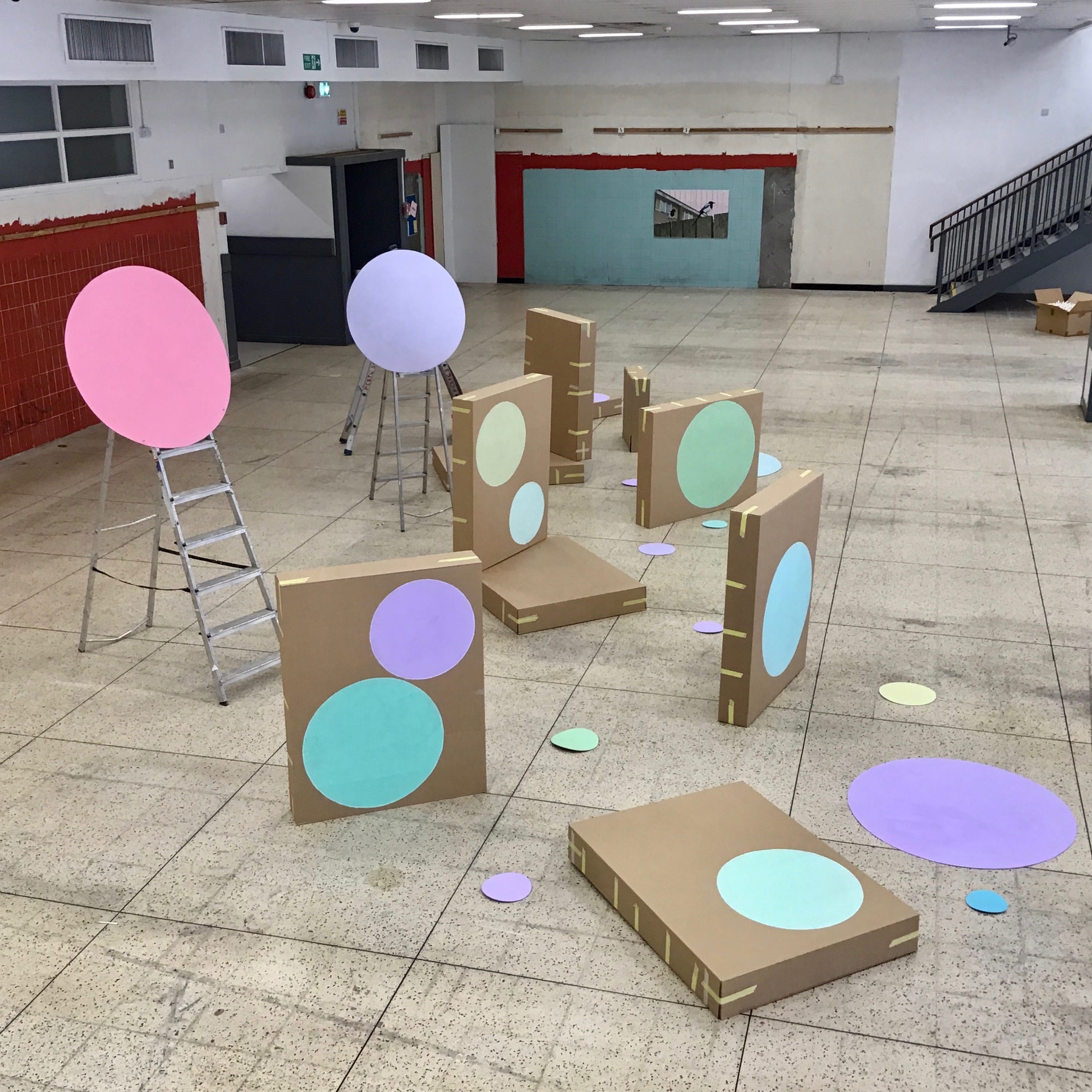
Saturday 12 July. 1.35pm. I step through the double doors and scan the shop floor, slowly, left to right, it takes shape, a display of pastel discs in the middle of the sales area, discs painted onto taped-up cardboard boxes, discs propped up on the rungs of ladders, discs scattered on the scuffed tiles, and, further off, other works on the walls, the plaster and ceramic, and I see Emma at the checkouts, with two or three people, lost in conversation, making introductions.
This used to be a Wilko, the local Wilko, it still says Wilko above the door but it hasn’t been a Wilko since September 2023. For ten years, and more or less weekly, I would call in to pick up adhesive tape, print supplies, cleaning products. Then it closed with a week’s notice and the loss of twenty jobs. In April 2025, the space reopened under the auspices of Hypha Studios, an arts organisation that matches creative projects to empty units. The first project in the old Wilko was The Drawing Shop, an artist-led collaboration with the public with an emphasis on inclusivity and accessibility, encouraging collective mark-making and creative play. The second project is an exhibition, curated by Thomas Griffiths, that reflects on the materiality (and absence) of retail. checked out opened last month and closes next week. It features work by 17 artists, including Emma Bolland, whose mixed media installation occupies the central space of the ground floor, and who has invited me to take part in a reading here this afternoon.
I find a few dozen paint-spattered chairs in an alcove and start to haul them out, stack by stack, and set them in rows in a corner of the space. Here is Conor Rogers, and here is Rachel Smith, artists and writers who will also be reading as part of this afternoon’s event, they say hello and help to separate and straighten up the last few plastic seats. It’s strange to see them here. It’s strange to see anyone here, the shelves stripped out, the walls a cracked patchwork, the aisles a faint afterimage. Only the checkout counters remain, and their meaning has changed, no longer sites of transaction, but social hubs, information desks. Emma has done most of the invigilation from here, fielding questions from passers-by who hover on the threshold, discussing the work with other participating artists, welcoming visitors who have made the journey from Manchester or Bolton or London. How to make sense of a space like this, other than to let the art make sense of it, and make a new use of it. It’s still strange, though. It’s strange to be reading lyric essays in an ex-shop less than five minutes’ walk from my house.
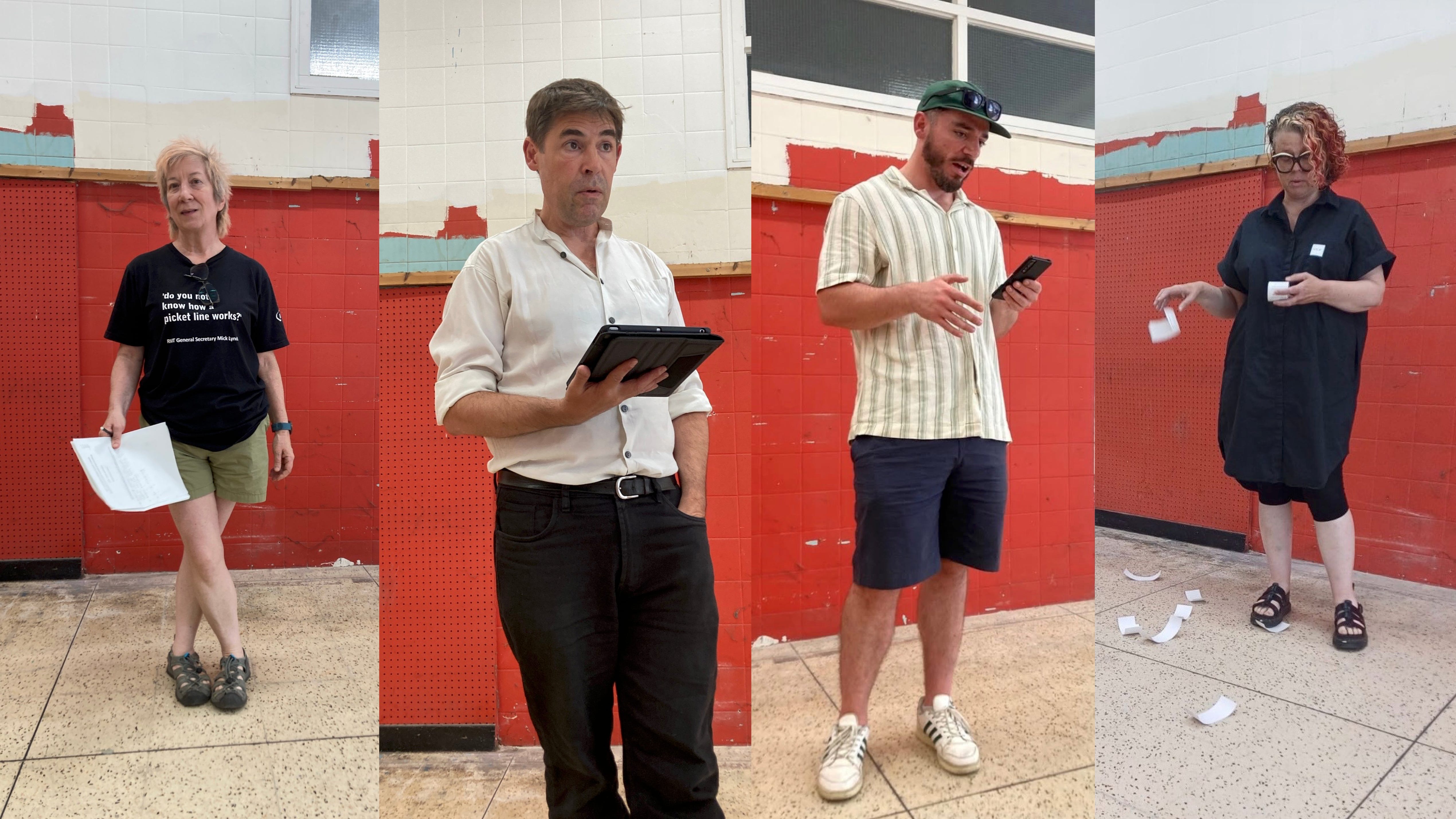
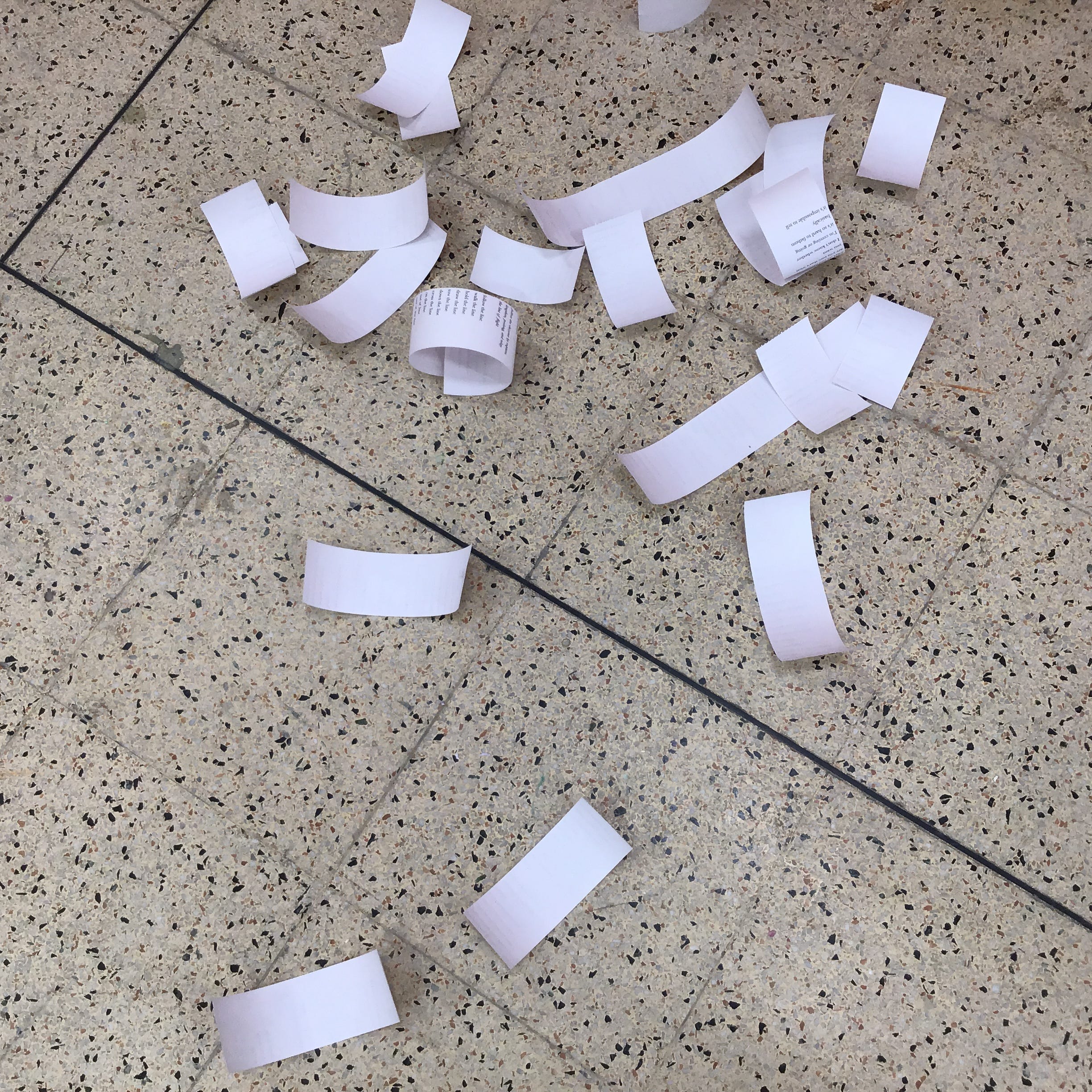
2.10pm. An audience of ten or twelve people, who weren't there when I last looked, has assembled, so we make a start. Emma introduces the event, then reads an extract from Sky Tangents from Clock Tower, itself a part of an ongoing transdisciplinary project, Three Building, that considers the possibilities for bodily autonomy in ‘total institutions’ (e.g. psychiatric hospitals). One section is titled ‘Notes made while drawing’. It’s such a simple idea and it stays with me. How one thinking space engenders another. I read a few passages from an as-yet-unpublished book-length work titled Local Distribution that developed from my practice of delivering books by hand, on foot, throughout the city. The extracts reflect on the status of department stores as ‘common ground on private land’ and what their gradual disappearance might mean. Conor is next, with some poems that draw on his experience of growing up on the Manor estate in south-east Sheffield. The work, and its delivery, is agile and astute, and its energy seems to spring from a restless questioning of one’s place; the nuance and complexity of class is both familiar and shifting ground, demarcating spaces of inclusion and exclusion, and the fluxes of longing and unbelonging. Rachel closes the event with a reworked version of 'Lines That Echo', almost unrecognisable from its published iteration (in the Sheffield anthology, Dostoyevsky Wannabe, 2019), the text of which is printed on a roll of bus tickets, which she discards as she reads, the spent tickets coming to rest on the shop floor. It’s a map of the city, a route to the city, a line through the city. It floats above the noise from passing mopeds and the bare breezeblock walls and the heat on the street nudging thirty degrees. Afterwards we talk of unexpected correspondences, overlapping themes in uncoordinated selections, and we stand and speak with no distance, neither artists nor audience now.
I’d all but given up on events at the start of the year. I still attended other people’s readings, launches, and openings, and usually enjoyed them. I staffed the Longbarrow stall at book fairs and handled book sales at readings given by Longbarrow poets but there were no Longbarrow events, none that I’d devised or organised, not since 2022. No decision, no announcement. 2023 was a bad year and so was 2024. There were myriad factors or perhaps just one or two factors but the outcome was a loss of connection. Not a total loss. I engaged with the poets, the press, the audience, but discretely, one at a time, and nothing was ever more than the sum of its parts. Over time, through chance encounters and impromptu chats, I discovered that many people had experienced or were experiencing something similar, a sense of falling out of sync, or out of step, with the city, the last few years of apparent stasis and rapid, almost convulsive, change resulting in the creation of new spaces, the loss of old spaces, and the off-and-on of the meanwhile spaces in which many of Sheffield’s creative conversations happen. It’s easy to lose one’s thread, or lose one’s place, when the foundations have shifted and there are few stable platforms.
Soft Ground was an arts and community space carved out of former retail premises in the middle of the city’s main shopping district that, for the three years in which it was active, also served as the HQ of Arts Catalyst, which set up and managed the venue. I caught perhaps a handful of the many events and exhibitions that took place there, prior to its closure at the end of June (due to the insecurity of its short-term ‘empty shop’ contract), and I valued it as much for the warmth and openness that flourished there as for its usefulness as a cultural resource. It was a space that seemed to encourage people to talk to each other (the ethos of its designers, Sheffield-based architectural practice Studio Polpo, was undoubtedly a factor in this) without an agenda. The subsequent relocation of Arts Catalyst to Exchange Place Studios in Castlegate, a redeveloped quarter in the north-east of the city centre, is intended to give the organisation a permanent home, as part of a neighbourhood of creative practitioners and voluntary organisations (the building is managed by Yorkshire Artspace). Perhaps Castlegate, with its sustainable linear park and emphasis on cycling and walking, is (or will become) an urban village. Perhaps Hillsborough, which has everything I need (a post office, a newsagent, a grocer, a river) within a five-minute walk, is another. In the spring of 2021, towards the end of the last lockdown, I made a number of deliveries, on foot, to addresses in Greenhill, Totley and Dore, near the border with Derbyshire, often returning via the western suburbs of Greystones and Ranmoor. My route passed through the city but the city was closed. It felt as though its cultural and economic power had been drained, or devolved to the outskirts. It doesn’t feel like that now. There’s a sense of circulation, or flow, and this has as much to do with people as it has to do with places.
In May, the poet Chris Jones got in touch to let me know that he’d been speaking with the owners of Novel, an independent bookshop that he’d discovered five minutes from his house in Crookes, about the possibility of a summer reading there. Also ongoing was a group discussion with several Longbarrow poets, and the proposed bookshop event was an outcome of this; I wasn’t privy to the discourse, but Chris mentioned that there was considerable support for the idea. A date was set for mid-July, the reading was announced with minimal publicity, and, in little more than a week, the event was fully booked. I was somewhat surprised by these developments, which contrasted sharply with the memory of a book fair that I’d attended the previous summer, a twelve-hour day that yielded £20 in sales. Time and money. What else. Chris was at pains to reassure me that I wouldn’t have to do much at the reading, other than unpack the books, arrange them on a table, and, perhaps, sell them. He would introduce the event, and the poets, and the running order would be agreed between them. This was a different way of working, a departure from almost two decades of agonizing over the particulars of our live programme, and refreshing, too. There was no need for me to demand a veto or a visible role. Step back. Let the work speak for itself.
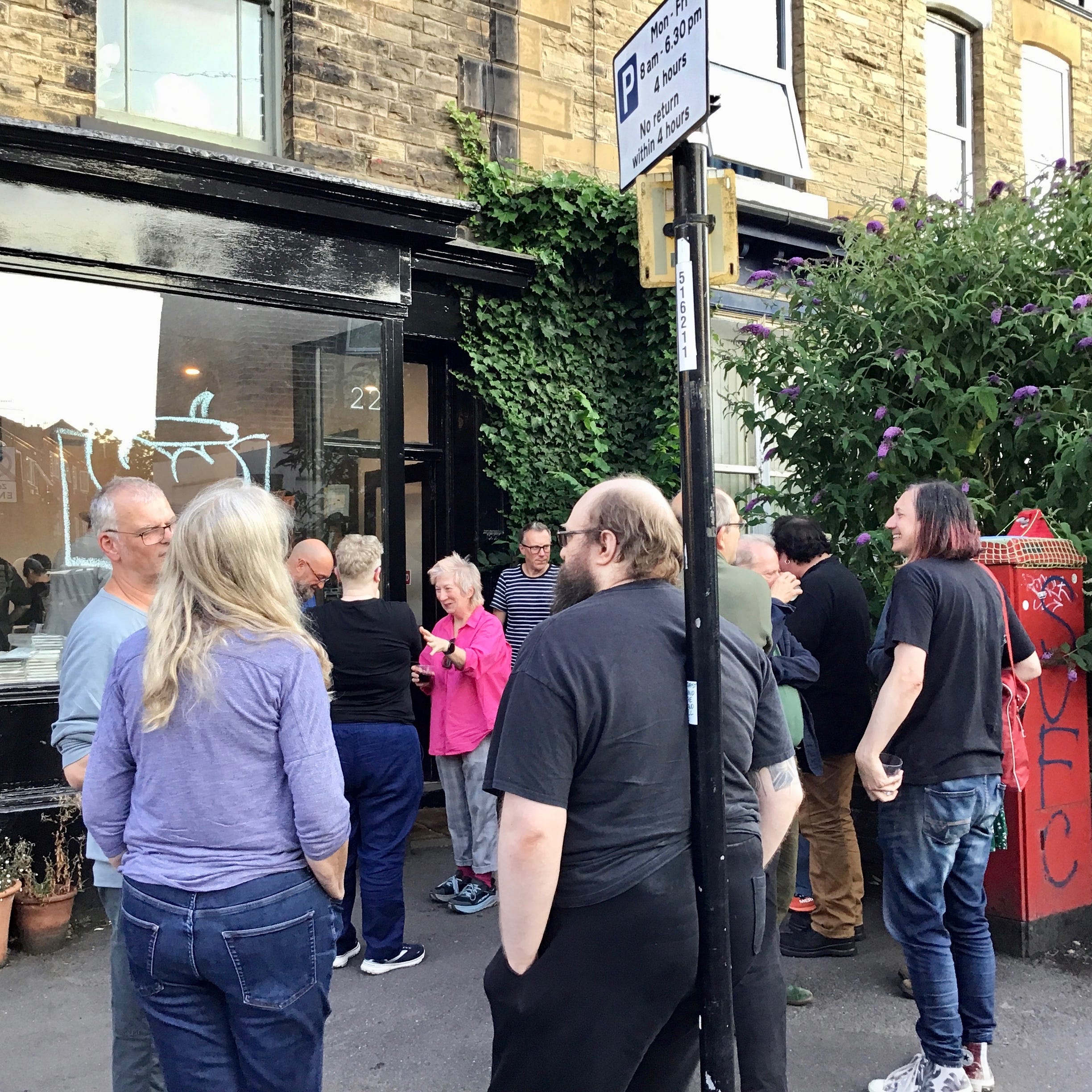
Wednesday 16 July. 6.15pm. Crookes is a short walk uphill from Hillsborough, twenty minutes or so, a little longer with a rucksack full of hardbacks. I knock on the glass-fronted door and Kate and Joe welcome me in. I haven’t met them until today, or set foot in the bookshop, but immediately feel at ease in this new setting. Novel started out as an itinerant stall, selling at markets and events in the city, before finding a niche in a (now-closed) café in Crookes, and then, in August 2024, moving to their current premises on School Road. It’s a well-designed store, open and uncluttered, with well-chosen stock. The handpicked selections are informed by customer recommendations, and the bookshop itself is a conversation, what would you like to see in this space, what would you like it to be. Joe invites me to set up at a table near the window and I unpack the books from their boxes. Chris arrives a few minutes later, then Jim, then Angelina, I dip in and out of the freewheeling chat as I finesse the table display. Soon the shop fills up with the thirty-strong audience and all of the poets are here. James Caruth. Matthew Clegg. Angelina D'Roza. Steve Ely. Pete Green. Chris Jones. Fay Musselwhite. Novel has two small event spaces, each of which can seat up to twenty people. Chris’s solution to the capacity issue is to divide the poets and the audience between the two spaces, with four poets reading upstairs, while three poets read downstairs, followed by an interval, after which each group of poets will change places (with the audiences remaining where they are). Everyone present will have the opportunity to hear all seven poets, apart from the poets themselves. Chris introduces the quartet in the room above, then joins Fay, Pete and the audience in the café adjacent to the bookshop, and delivers the second introduction. I lean in the doorway and listen. Normally I would be taking photos, documenting the event, but it seems intrusive, at close quarters, and unnecessary. The readings are short, between seven and ten minutes each, and frequently surprising. Some of the poets take up the theme of reconnection (suggested by Matt), while others adopt a more singular approach, but the event itself is reconnection, with people, with poetry, and a sense of the possible. Chris opens with a poem that he debuted at the first Longbarrow event in 2006. Jim’s set is drawn entirely from his sequence Tithes. Fay offers an extended preview of her next book. Steve makes an uncompromising selection from Eely. Pete reads a single long poem from Hemisphere, which then sells out in the interval, so makes an impromptu decision to read from Sheffield Almanac in the second set. Angelina spontaneously abandons her planned reading and plucks several different poems from The Blue Hour. Matt responds to this with some improvisations of his own, which cue into the haibun of his as-yet-unpublished serial collection Have You Always Been Here? And it works. Somehow, it all works, even though none of us can see the full picture. Those of us downstairs don't quite know what is happening upstairs, and vice versa, yet we leave not with a sense of incompleteness, but of having witnessed something unique. It’s an approach born of necessity, and illustrative of how we’ve always worked, trying one thing, then trying another, and making each moment count. You can't be in two places at once.
The next Longbarrow Press reading takes place at Mecycle Cafe & Bike Workshop, Ainsdale, Merseyside, on Wednesday 3 September, with Pete Green, Chris Jones, Fay Musselwhite and Helen Tookey. The event is fully booked; if you would like to attend, please click here to join the waiting list.
Click here to browse and buy current Longbarrow Press titles.
I miss Sheffield 😢